The Bank Statement: Where This Balance Comes From
A holiday, sick time or overtime balance can sometimes come as a surprise: a number lower or higher than expected, without knowing why. For example, a ceiling that withheld accrued hours, or a first week on the job that did not count a full cycle. The bank statement details on screen, line by line, how a balance was built.
To follow the instructions in this article, you will need access to the manager features, or to be responsible for a team.
Where to Find a Bank's Statement?
Go to the "My team" page. On a person's card, click on the balance of the bank you are interested in: the number itself is clickable, and the statement unfolds right below it.
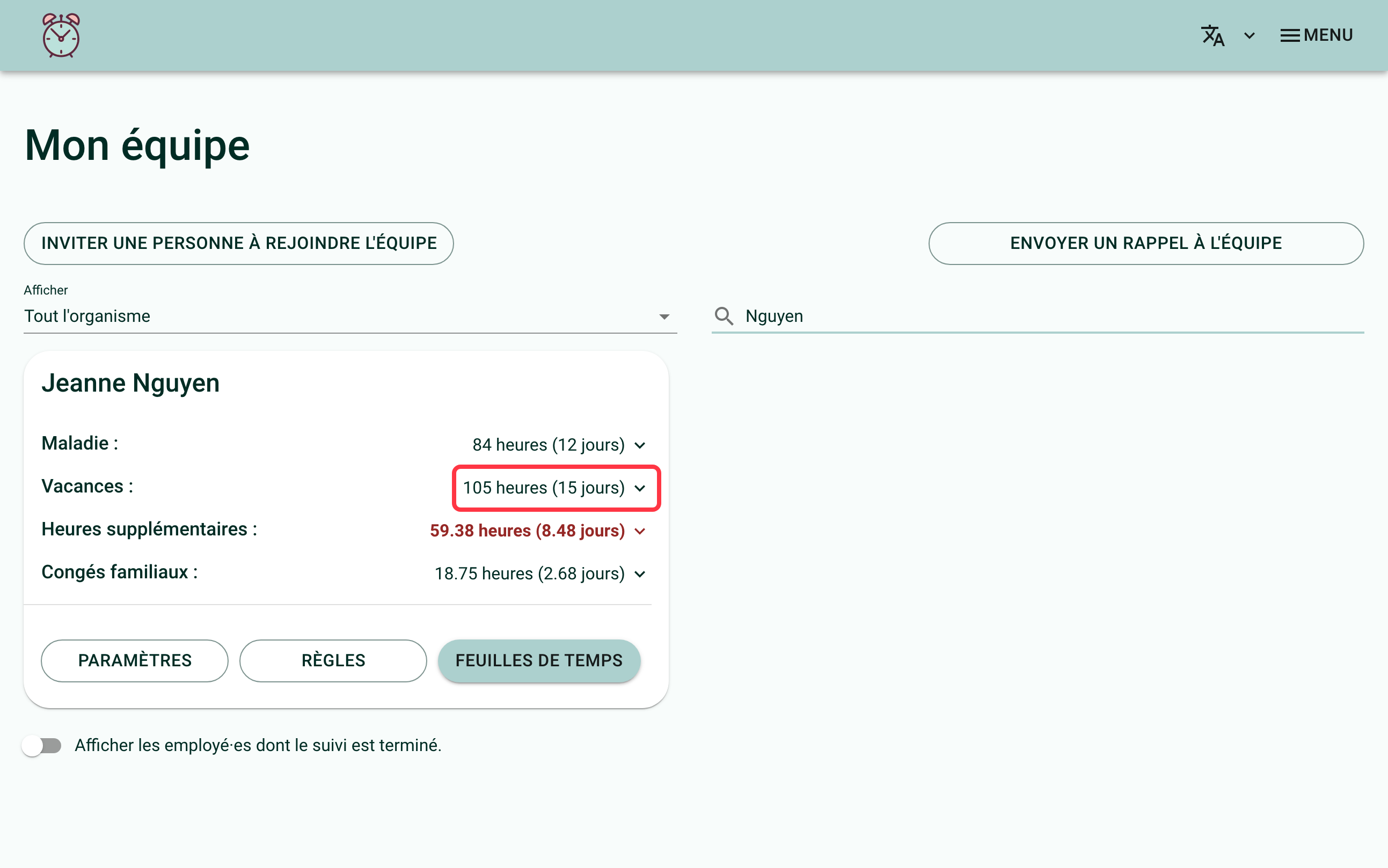
Only managers and team leads have access to the statement. A team lead only sees it for people on their own teams, as with the rest of the "My team" page.
How to Read the Summary?
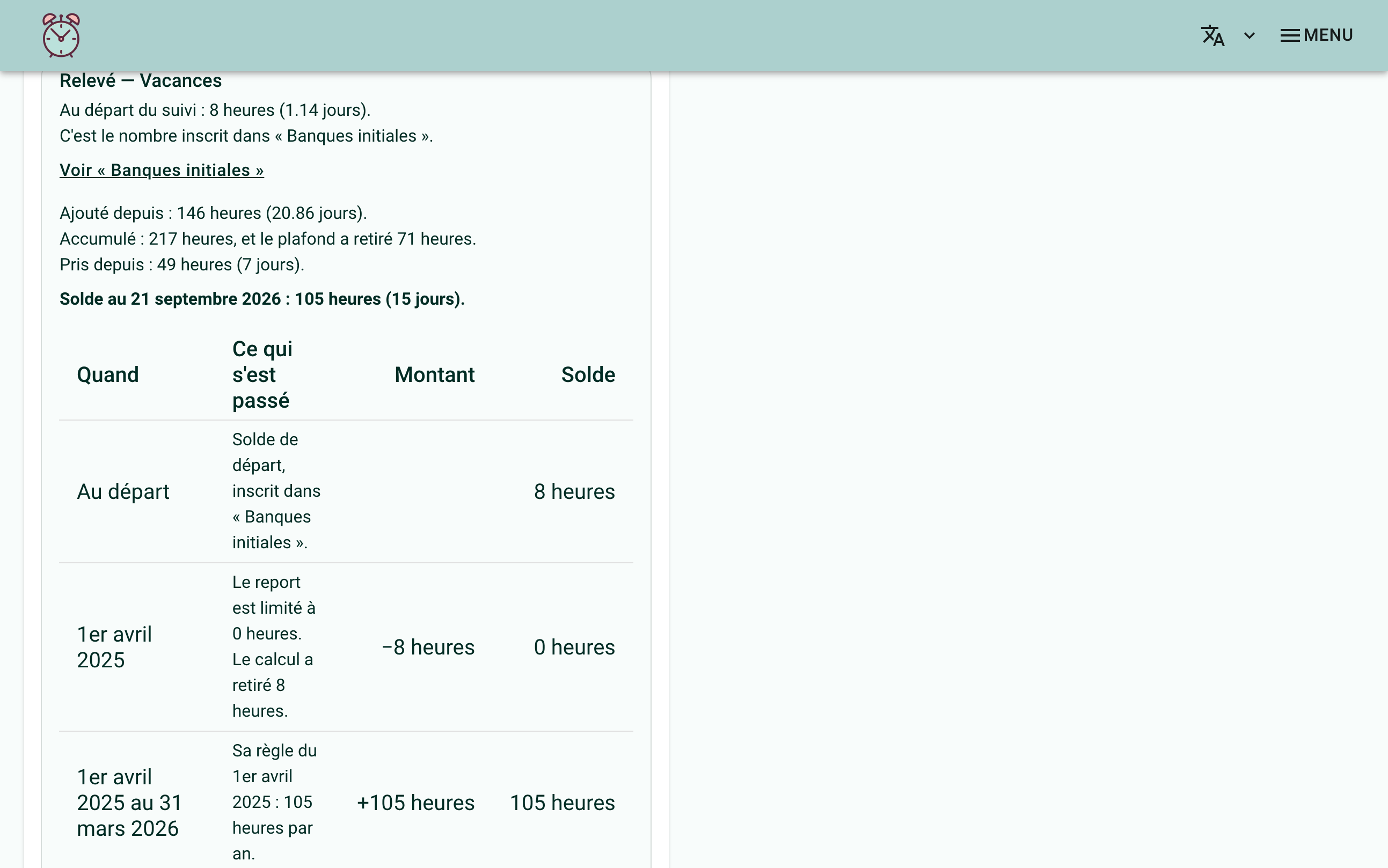
At the top of the statement, a few lines answer the most common questions at once. "At the start of tracking", "Added since", "Taken since" and "Balance on [date]" are always there; the others only show up when they have something to say:
- At the start of tracking: the person's starting balance, with a link to the "Initial banks" field where it was entered.
- Added since: what the bank has accrued since then. If a ceiling withheld part of that amount, a line right below it says so.
- Taken since: the leave used since the start of tracking.
- Expired before being used: hours that were not taken in time and are no longer available, when the bank has such a limit.
- Adjustments: the total of the entries posted by hand, if any, see Adjusting a Bank Balance.
- Balance on [date]: the current balance, in bold. It is the same number shown on the person's card.
How to Read the Detail, Line by Line?
Below the summary, a table lists every event that moved the balance, in the order it happened: when, what happened, the amount, and the resulting balance.
| What you see | What it means |
|---|---|
| "Starting balance, entered under 'Initial banks'." | The starting point of the statement: the number entered when the person started. |
| "Their own rule of [date]: X hours per [cycle]." or "The organization rule of [date]: X hours per [cycle]." | Which rule applied to this period, the person's own or the organization's, and since when it has been in force. See Managing Rule Changes for an Employee if this line surprises you. |
| "Counted for X days out of Y." | A period shorter than a full cycle, most often the very first one: it only grants part of the usual amount. |
| "The balance was at the ceiling of X. The calculation removed Y." | The bank's maximum accrued amount was reached: this period's allocation was reduced accordingly. |
| "The carry-over is limited to X. The calculation removed Y." | At the carry-over deadline, the balance was above the ceiling set in the rules: the surplus was removed. See Configuring the Hour Bank Calculation Method for this setting. |
| "Leave taken: X." | Hours from this bank were used during this period. |
| "The window to use these hours has closed: X." | Accrued hours were not taken in time and are no longer available. |
| "Adjustment recorded." | A manual entry changed the balance on this date. |
| "This bank accrues in money. At X an hour, Y make Z." | For a holiday bank calculated as a percentage: the calculation is done in dollars, then the result is converted back to hours. |
A Worked Example
Isabelle starts tracking on April 1 with 20 hours of holiday time already accrued at her previous job, entered under "Initial banks". Her organization grants 140 hours of holiday time every April 1, with a maximum accrued balance of 150 hours. In July, she takes 30 hours of holiday time.
The statement for her holiday bank would show:
- At the start of tracking: 20 hours.
- Added since: 130 hours. 140 hours accrued on April 1, and the ceiling removed 10 hours, because 20 hours already in the bank plus 140 accrued hours would have gone over the 150-hour ceiling.
- Taken since: 30 hours.
- Balance on [today's date]: 120 hours.
And in the detailed table, two lines: the April 1 grant (+140 hours, with the note that the ceiling removed 10 hours), then the July leave (-30 hours).
What About an Overtime Bank?
The same principle applies to every bank: holiday, sick time, overtime, compensatory time, family leave or a possible second bank of specific leave days, depending on what your organization has configured.
Marc starts tracking on January 1, with no overtime in the bank. In February, he works 6 hours of overtime. In March, he takes 4 hours back.
The statement for his overtime bank would show:
- At the start of tracking: 0 hours.
- Added since: 6 hours.
- Taken since: 4 hours.
- Balance on [today's date]: 2 hours.
If you need help with this, write to us at support@feuilledetemps.ca.