Configuring the Hour Bank Calculation Method
The method for calculating vacation and sick leave hour banks can vary from one organization to another.
In some cases, hours are credited at the start of the fiscal year or contract and then deducted as needed. In other cases, hours are accumulated gradually.
Feuille de Temps adapts and automatically calculates hour banks once the rules are configured for your organization.
To follow the instructions in this article, you will need access to the manager features.
How to Configure the Hour Bank Calculation Method for the Organization?
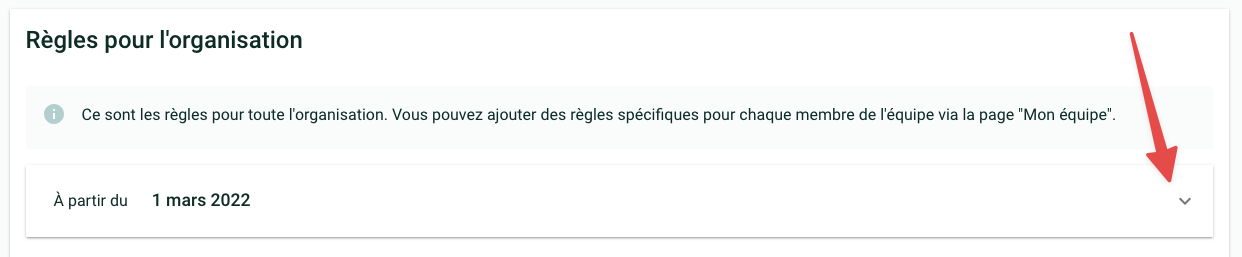
Go to the "My Organization" page, scroll down to the "Organization Rules" section, and click on the current period to view its details.
Accumulation Method
The "Hours are earned" field sets when hours enter the bank.
Five options are available:
- at the start of the fiscal year: the year's hours are credited in one go, on the first day of the organization's fiscal year.
- at the start of hours tracking: the hours are credited in one go on the person's first day, then on each anniversary of that day.
- first day of each month: the month's hours are credited on the first day of each month.
- along the way: hours accumulate week after week, as timesheets are filled in.
- at a specific date: the hours are credited in one go on a date you choose, which then comes back every year. This is the option for organizations whose leave cycle follows neither the fiscal year nor the person's start date.
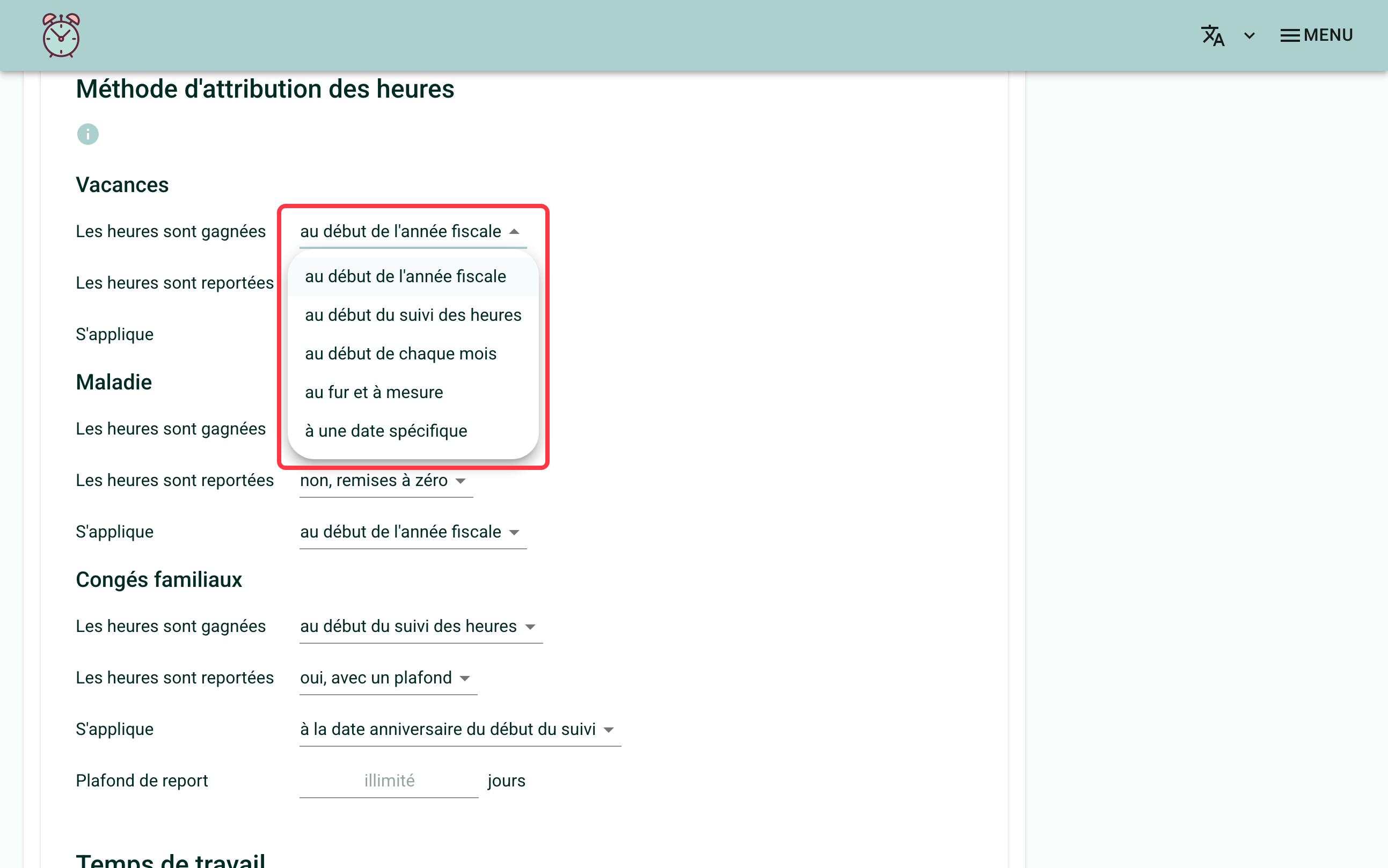
Each bank has its own method: vacation, sick leave, family leave and a possible second bank of specific leave days are set separately.
A Different First Year for a Person Who Joins
For a bank whose hours are earned "at the start of the fiscal year", a field titled "In a new person's first year" appears right below it. It offers two answers:
- like the other years (the default value): the person gets the fiscal year's full amount, like the rest of the team.
- along the way: during the fiscal year they are hired in only, the person accumulates this bank week by week instead of getting the amount in one block. From the following fiscal year on, they automatically switch back to the full amount, like everyone else.
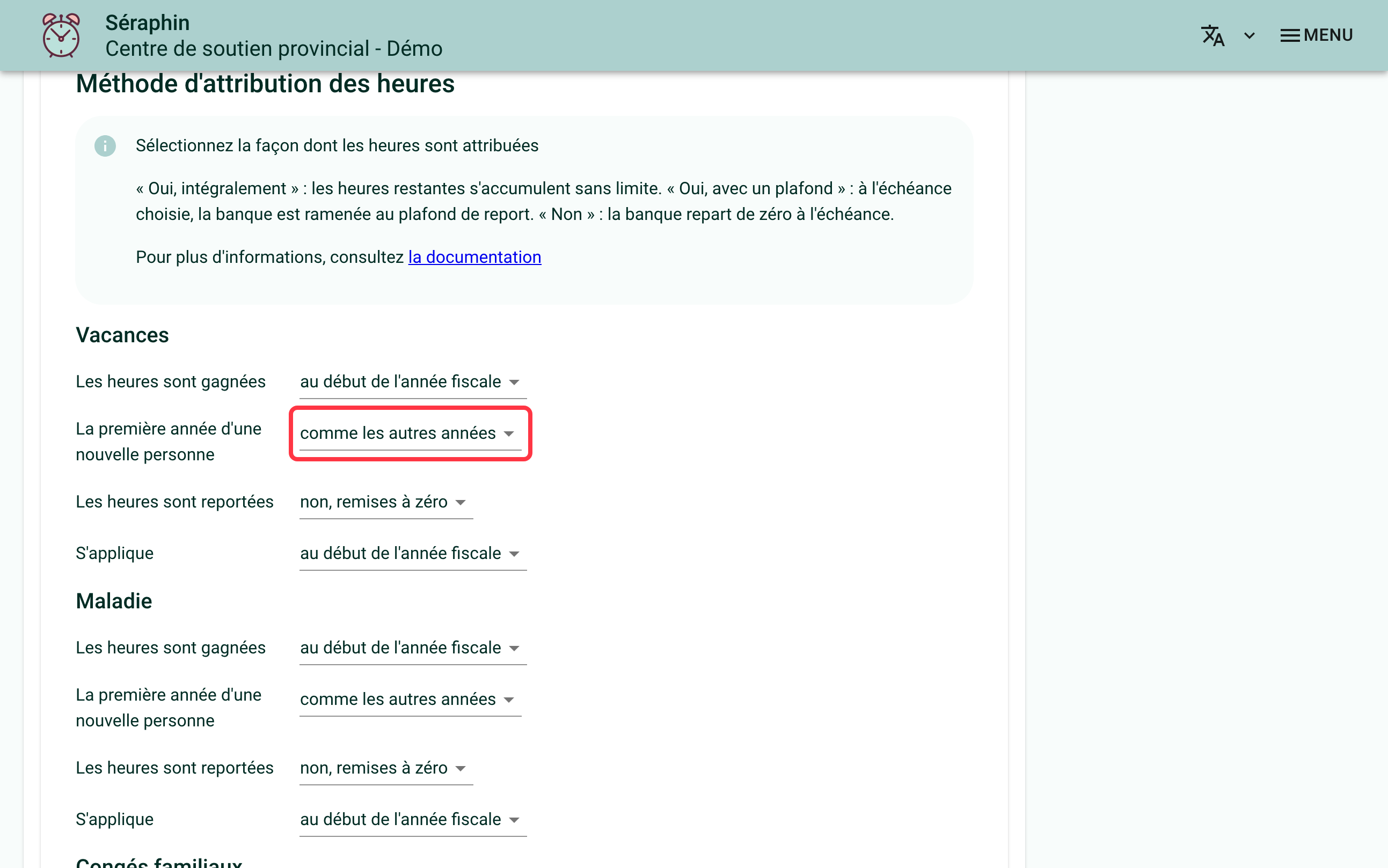
This setting only applies to people hired after your organization started using Feuille de temps; people already tracked before that date are not affected.
This field only appears under a bank set to "at the start of the fiscal year": vacation, sick leave, family leave or a possible second bank of specific leave days. It is set for the whole organization; it does not exist yet on an individual person's rules.
Carrying Hours Over
The "Hours are carried over" field answers a different question: what happens to the balance left at the end of a cycle?
- yes, in full: the remaining hours pile up with no limit.
- yes, with a cap: at the chosen boundary, the bank is brought down to the cap. A "Carry-over cap" field, in days, then appears.
- no, reset to zero: the bank starts again from zero at the boundary.
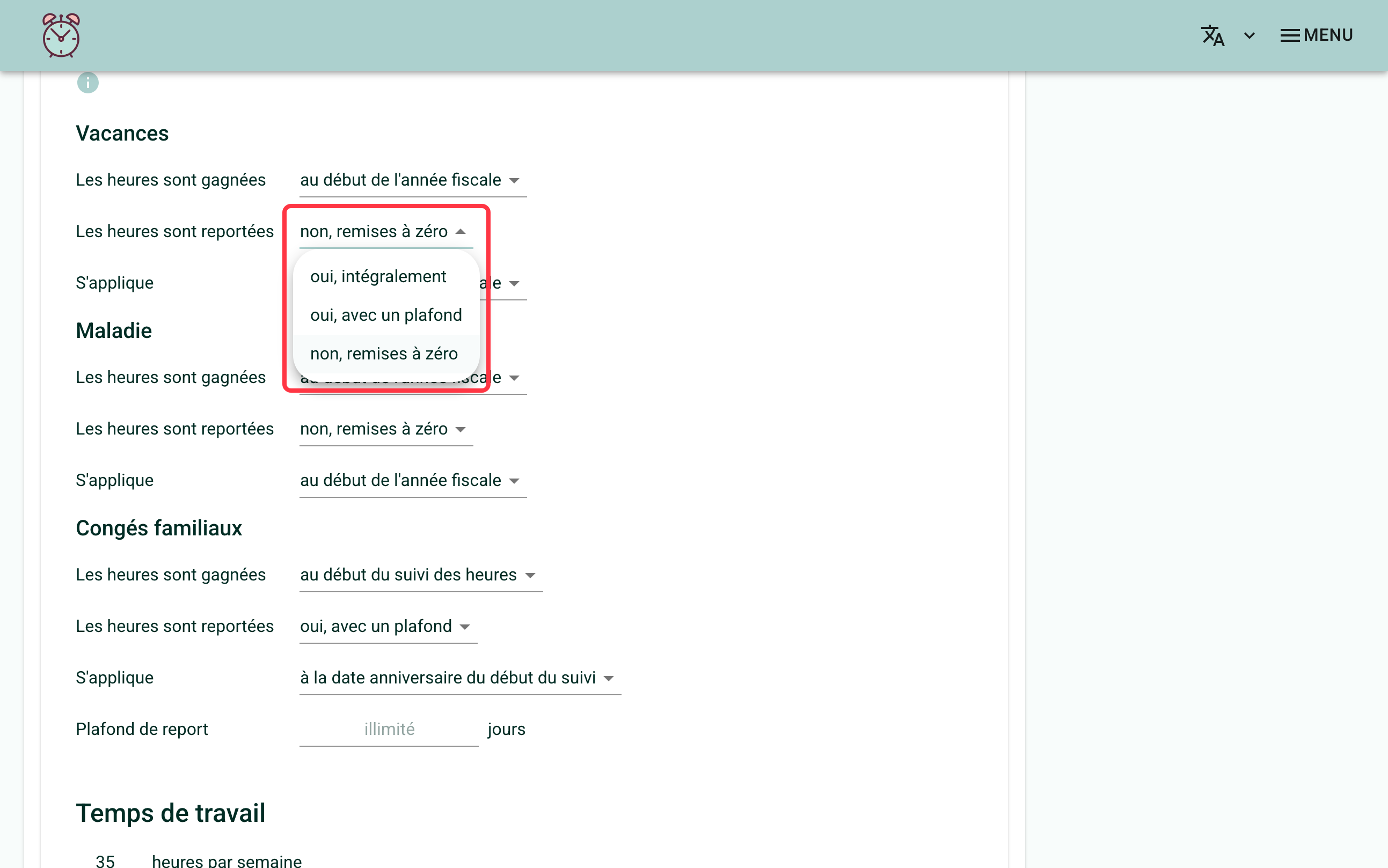
As soon as the carry-over is not "in full", an "Applied" field asks for the boundary. Its choices depend on the accumulation method:
| Hours are earned | Applied |
|---|---|
| at the start of the fiscal year | at the fiscal year start |
| at the start of hours tracking | on the tracking start anniversary |
| first day of each month | at the fiscal year start, or at the start of each month |
| along the way | at the fiscal year start, or on a specific date |
| at a specific date | on a specific date |
The "on a specific date" boundary lets an organization whose hours accumulate along the way trim the balance on a fixed date (1 January, for instance) rather than at the start of its fiscal year.
The Anchor Date
An "On the anchor date" field appears as soon as the accumulation method or the carry-over boundary is set to a specific date. It is required: without it the calculation has no reference point and the bank cannot be saved. Each bank has its own anchor date.
That date is a yearly appointment: its day and its month are what come back from one year to the next. An anchor date on 1 April places the boundary on 1 April every year.
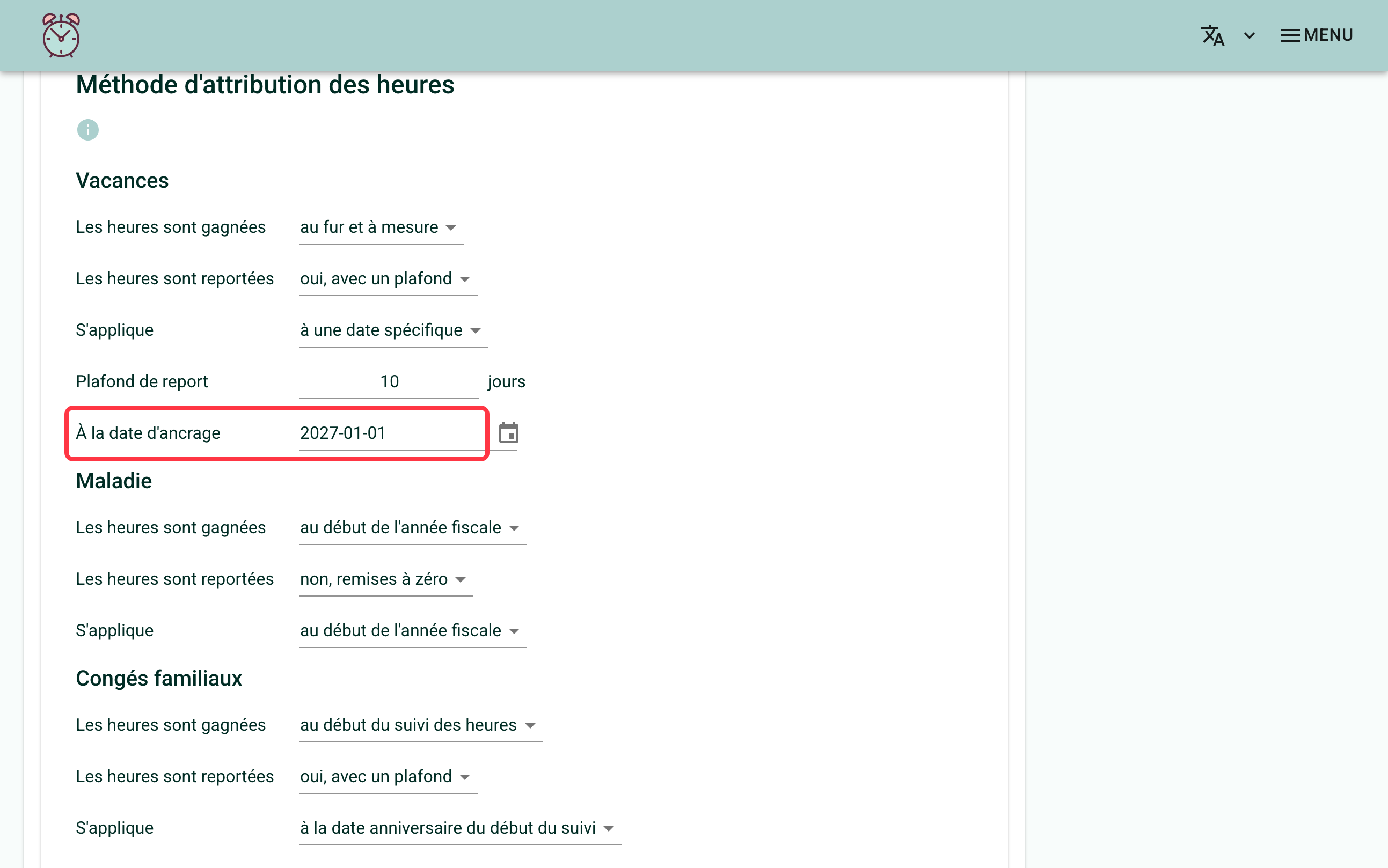
When "at a specific date" is the accumulation method, the anchor date also marks the start of the bank's calculation: nothing is credited before it. So pick a date on or before the start of hours tracking for your team. An anchor date in the future would leave the banks at zero until that day.
The First Period
A bank credits its hours by cycles: a fiscal year, a month, a year counted from the anchor date. The very first one is almost always shorter than the ones that follow: it runs from the start of hours tracking to the next boundary of the cycle. Someone starting on 15 November in an organization that credits on the first day of each month has a first period of sixteen days, not thirty.
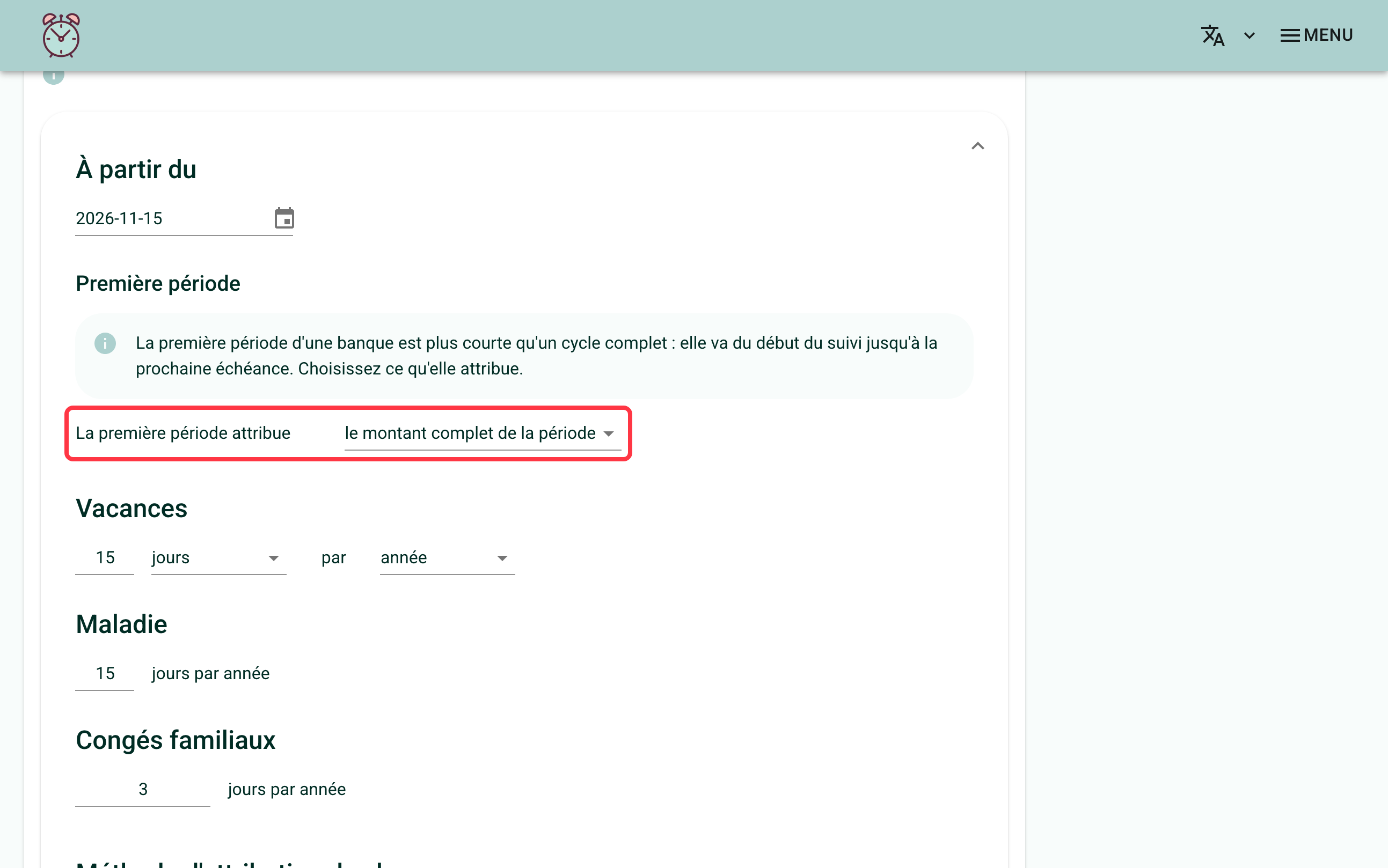
The "First period" block asks the question this raises, and the "The first period allocates" field offers two answers:
- the full amount of a period: the person gets the whole month, or the whole year, even though they only lived part of it.
- in proportion to the days it covers: they get the share matching the days actually covered. The proportion is computed on the real length of the cycle, not on a theoretical 365-day year: a transition fiscal year, shorter or longer than twelve months, is therefore counted for what it lasts.
Neither answer is more correct than the other: it is your organization's convention, and it genuinely differs from one organization to the next. The prorata usually matches the reality of someone arriving mid-period.
The block only appears when the question arises, that is, when the rule period's "From" date does not fall on a boundary of the cycle. When it falls exactly on one, there is no partial first period and the field stays hidden.
The same block exists in a person's own rules, when they are on rules of their own. It then governs their first period, the one starting when they came on board.
There is only one first period per person. A rule dated after the start of their hours tracking therefore does not govern it, and the block does not appear there: the rule in force when that first period begins is the one that decides. If you create a new rule period for someone already on board, this setting is not the one that will move their balance: see Managing a rule change for an employee.
If one of your rules displays "Nothing, allocation starts with the first complete period", that is the value it carried before this setting existed: the first period allocates nothing at all. It stays displayed and re-saveable as is, but it is no longer offered as a new choice.
Carrying Overtime Hours Over
The overtime bank has no accumulation method: it is always the sum of the overtime hours worked, never an amount credited ahead of time. So the "Hours are earned" field does not exist for it: only its carry-over is configured, in the "Overtime" section of the organization's rules.
The "Hours are carried over" field offers the same three choices as the other banks, with three differences to know:
- The "Applied" boundary offers a single choice for this bank: "at the fiscal year start".
- The "Carry-over cap" field counts in hours, not in days like the other banks. The unit shown next to the field confirms it.
- This setting is organization-wide only: it does not exist in a person's own rules.
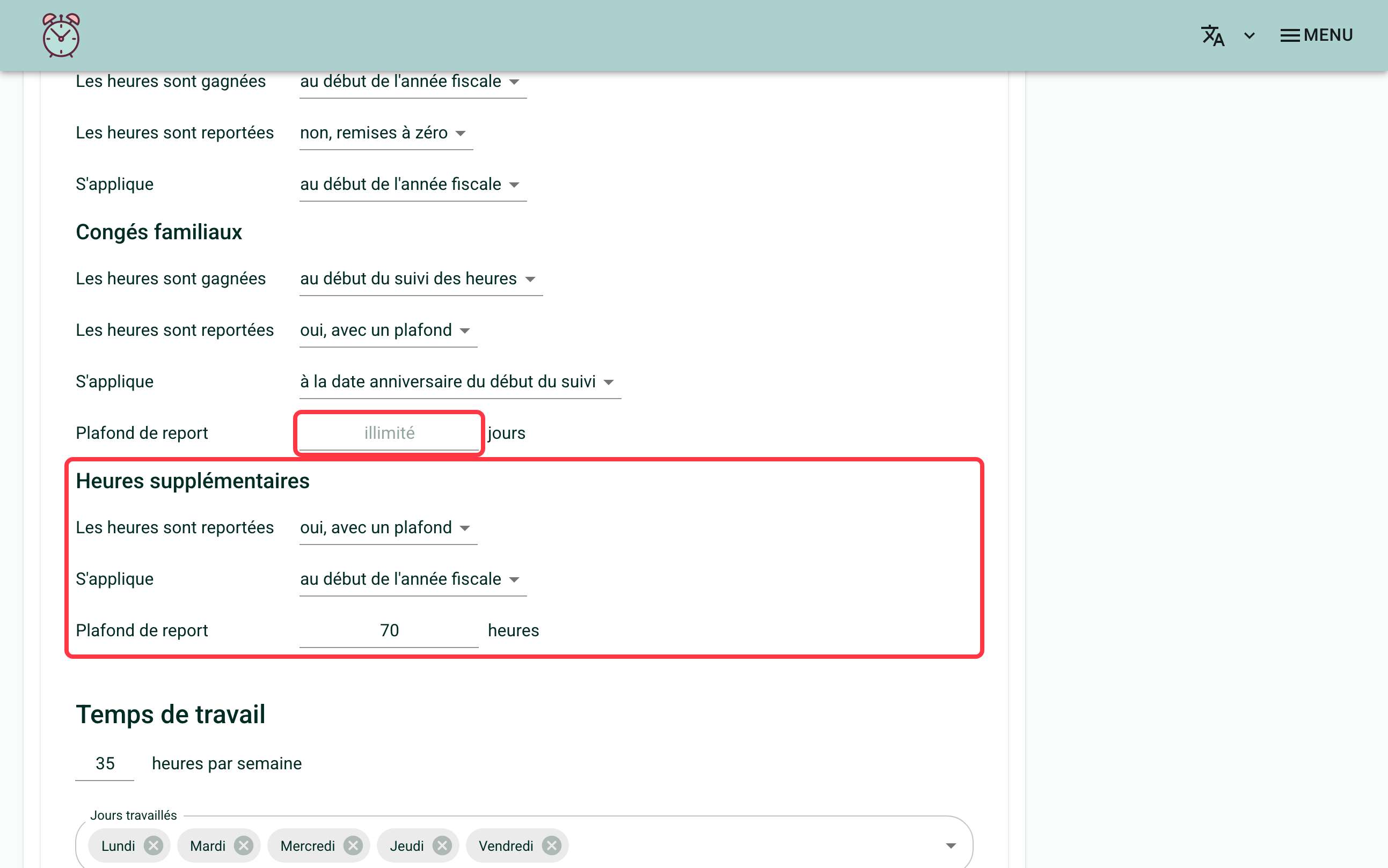
Turning on a carry-over that is not "in full" applies from the start of the rule period you are editing, not only to the years ahead. Since the current period usually starts at the very beginning of the account, that most often means recomputing from the origin, and your team's balances can drop as soon as you save. Before sending such a change, Feuille de temps asks you to confirm it, naming the date concerned: see Managing a rule change for the organization for the detail of that confirmation.
The effect is not marginal: within a team, several people can see their balance drop at once, by several dozen hours for those who had accumulated the most.
Creating a new dated period leaves the past alone: the years already elapsed keep the rules that were theirs. But beware: the loss is not avoided, it is postponed. The cap trims the accumulated balance at the first boundary it meets, including hours earned before that period.
To start again from a precise balance on a given date, use a bank adjustment instead: it is the only move that does not recompute anything backwards. And to choose between editing a period and creating one, see Managing a rule change for the organization.
Save
Click "Save," and the calculation will be automatically updated for your entire team.
When you change method, the displayed balance may move: the old and the new method do not compute hours the same way. To start again from a precise balance (for example to reset a bank to zero on the day of the change), use a bank adjustment. See Adjust a bank balance.
Why Does a Bank Stop Growing?
Some organizations also set a maximum of cumulated hours. As long as the balance stays below it, everything works as usual. As soon as it reaches that maximum, the bank stops growing: the following allocations add nothing at all, and no message says so on screen.
That maximum is expressed in days for vacation, sick leave, family leave and a possible second bank of specific leave days, and in hours for overtime. The days are converted into hours from the person's schedule: a maximum of 30 days is worth 150 hours for a 5 hour day, and 210 hours for a 7 hour day.
The Cumulated Maximum and the Carry-Over Cap
These are two different limits, and they act at two different moments.
| Carry-over cap | Maximum of cumulated hours | |
|---|---|---|
| When it acts | at the boundary chosen in "Applied", once per cycle | at every allocation of hours |
| What it does | brings the balance down to the cap | keeps the balance from climbing any higher |
| Where it is set | in the organization's rules, "Carry-over cap" field | with us, when your organization is configured |
A bank can therefore stay under its carry-over cap all year and still stop growing along the way, because it has reached its cumulated maximum.
What to Do When a Bank Is Stuck at Its Maximum?
Taking leave brings the balance back down, and the next allocation starts adding hours again. The hours that could not enter in the meantime are lost: they are not set aside anywhere.
If that maximum no longer matches what your organization wants to apply, write to us. This setting is made with us: it does not appear in the rule screens.
To see exactly when a ceiling or a carry-over withheld hours on a person's bank, see The Bank Statement: Where This Balance Comes From.
Examples
Organization A
- Vacation hours start at 0 at the beginning of the fiscal year and then increase gradually.
- Vacation hours are carried over from one fiscal year to the next, with no limit.
- Sick leave hours are credited in one go on the person's first day.
- Sick leave hours are not carried over from year to year.
The configuration to choose is:
- Vacation: "Hours are earned along the way", "Hours are carried over yes, in full"
- Sick Leave: "Hours are earned at the start of hours tracking", "Hours are carried over no, reset to zero", "Applied on the tracking start anniversary"
Organization B
- Vacation hours are credited at the start of the fiscal year.
- Vacation hours are not carried over from year to year.
- Sick leave hours are credited monthly.
- Sick leave hours are not carried over from month to month.
The configuration to choose is:
- Vacation: "Hours are earned at the start of the fiscal year", "Hours are carried over no, reset to zero", "Applied at the fiscal year start"
- Sick Leave: "Hours are earned first day of each month", "Hours are carried over no, reset to zero", "Applied at the start of each month"
Organization C
- Overtime hours pile up along the way, as they always do for this bank.
- On the first day of the fiscal year the balance cannot exceed 70 hours, and the surplus is lost.
The configuration to choose is:
- Overtime: "Hours are carried over yes, with a cap", "Applied at the fiscal year start", "Carry-over cap 70 hours"
Organization D
- Vacation hours accumulate along the way.
- The fiscal year starts on 1 April, but the vacation balance is brought down to 10 days on 1 January, and the surplus is lost.
The configuration to choose is:
- Vacation: "Hours are earned along the way", "Hours are carried over yes, with a cap", "Applied on a specific date", "On the anchor date" a 1 January (the year hardly matters here, the day and the month are what come back), "Carry-over cap 10 days"
Organization E
- Sick leave hours are credited in one go on 1 September, which opens the organization's leave year.
- Whatever is left on 31 August is lost.
The configuration to choose is:
- Sick Leave: "Hours are earned at a specific date", "Hours are carried over no, reset to zero", "Applied on a specific date", "On the anchor date" the 1 September preceding the start of hours tracking for the team
If you need help with this, write to us at support@feuilledetemps.ca.