Managing Rule Changes for an Employee
Sometimes an employee's contract evolves, for example, if they get more vacation days or change their weekly working hours.
In some organizations, additional vacation or sick days are granted with years of experience.
Feuille de Temps allows you to manage these changes while keeping a record of the previous rules. This is possible through the creation of periods.
To follow the instructions in this article, you will need access to the manager features.
How to Create a New Period for an Employee?
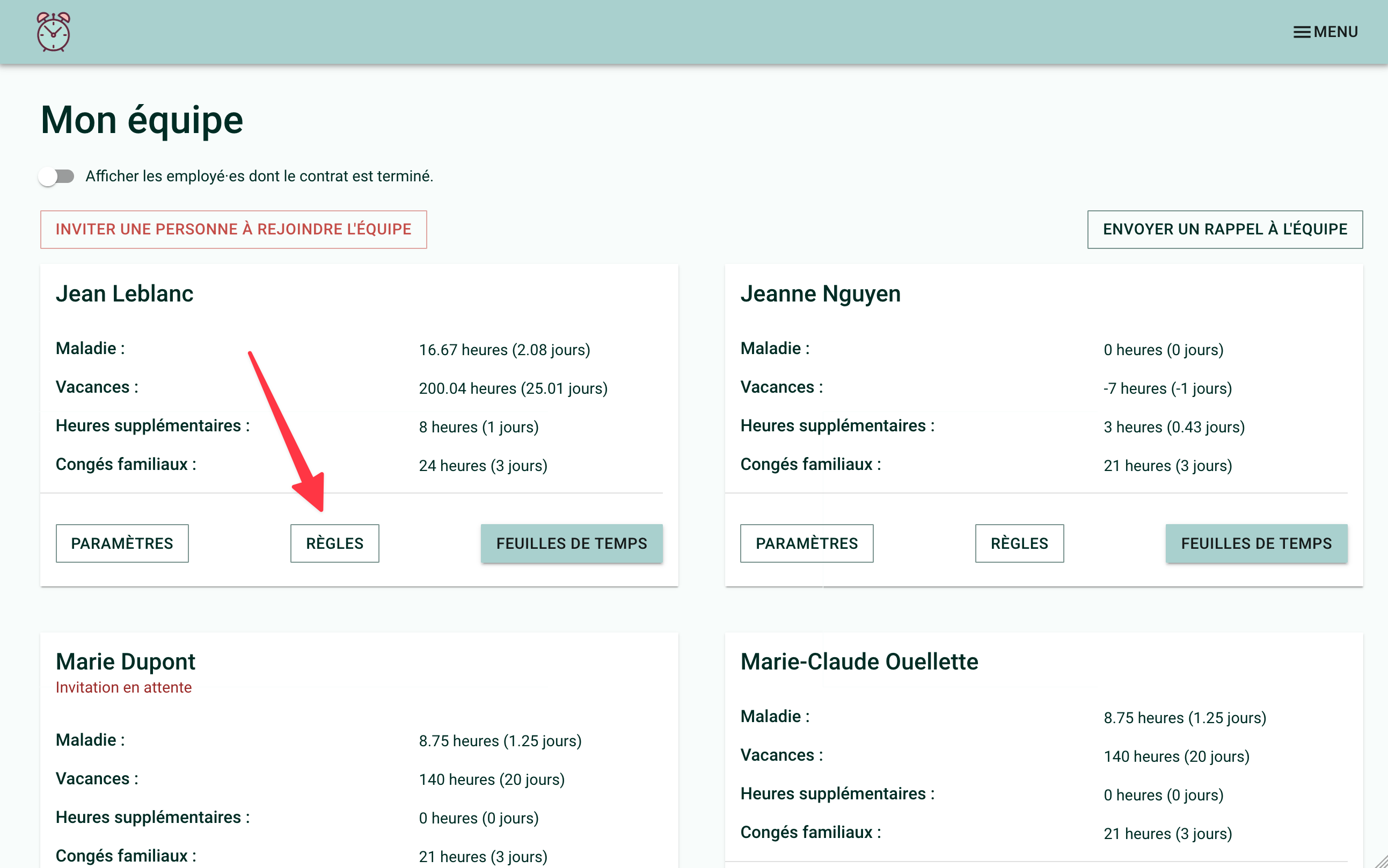
Go to the "My Team" page, then click on the "Rules" button in the employee's section whose contract has changed.
Create a New Period
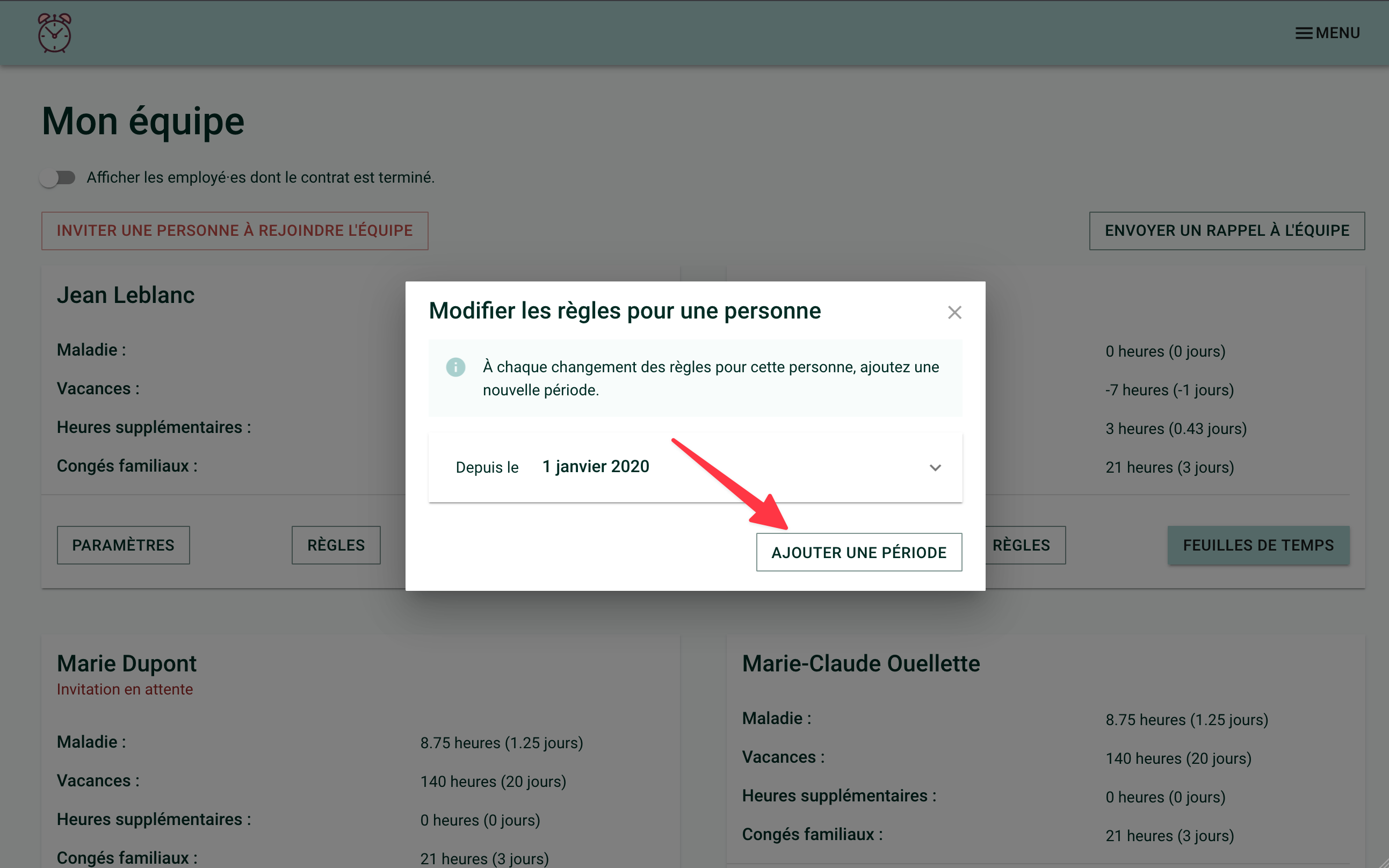
Click "Add a Period" to create the new period.
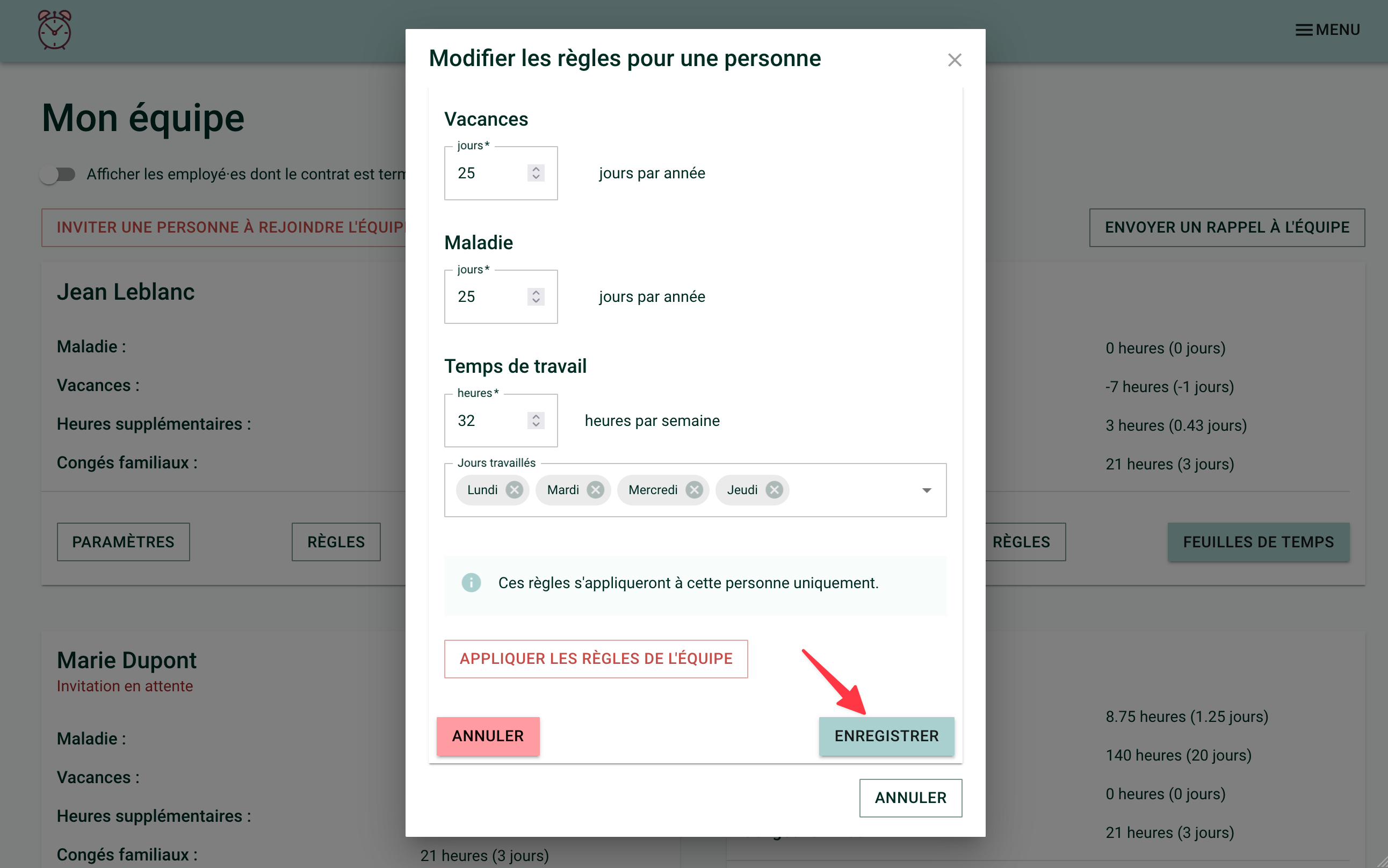
Fill in the start date and the new rules for this period, then save.
Close the Current Period
A period is automatically closed when a new one begins.
Edit the Current Period, or Create a New One?
The two are not the same, and it is a frequent source of surprises.
A rule period applies to its whole duration. Editing a period therefore recalculates the banks from that period's first day, not from today.
The current period usually starts at the very beginning of the account. Editing it therefore recalculates the banks from the origin. Balances can then move for weeks signed a long time ago.
The rule of thumb:
- Fixing a data-entry mistake (a value wrong from the start): edit the current period. That is exactly what you want, since the figure was wrong all along.
- Applying a real change of terms from a date onward (more vacation days, a move to a four-day week): create a new dated period, as explained above. History stays correct and only the weeks from that date on are affected.
Two periods cannot share the same start date. If the save is refused because a rule already exists on that date, edit the one that is there rather than adding a second.
This applies to all of a person's rules, including their specific public holidays. See Different public holidays for one person.
Does a Confirmation Appear Before Saving?
Yes. Click "Save" on a period that has already started and that you have actually changed, and a confirmation appears at the bottom of the form, before anything is sent:
This period has already started You are editing the rule period that starts on April 1, 2025. A period applies to its whole span: the banks of that person will be recalculated from that date, including weeks that are already signed.
Two buttons are offered:
- "Do not save": nothing is sent, your entry stays on screen.
- "Save anyway": the change is sent.
Three things to know:
- it only appears if you have actually changed the form: reopening it and saving without touching anything does not trigger it;
- it also appears when you create a period dated in the past, with a wording of its own: "This new rule period starts on April 1, 2025, in the past." A new period dated today or this week does not trigger it;
- it informs, it does not block. Editing a period already in progress is exactly the right move when a value was wrong from the start.
What Does the "Vacation is calculated in percentage" Switch Change?
In a person's "Rules" window, the vacation section carries a "Vacation is calculated in percentage" switch. It replaces the number of days per year with a percentage, the one used by agreements that pay 4 % or 6 % of the payroll.
An Hourly Rate Becomes Required
Once the switch is on, vacation accumulates in dollars rather than in hours: it is an amount earned. An "Hourly rate" field therefore appears in the same form, and saving is refused while it is empty, with the message "Hourly rate is required when vacation is percentage-based or overtime is in money."
The balance itself is still displayed in hours: the amount accumulated is divided by that hourly rate. Changing the hourly rate therefore moves the displayed balance, without a single hour of vacation having been taken.
For someone with "No fixed schedule", the switch is on and cannot be turned off. With no reference schedule, the percentage is the only way to compute their vacation.
How Much Accumulates?
The percentage applies to the hours of the person's schedule. For a 15 hour week, a 4 % rate and hours earned on the first day of each month: 15 h × 52 ÷ 12 = 65 hours per month, of which 4 % makes 2.60 hours per month.
Why Doesn't the Balance Move Right Away?
The switch is part of the dated rules, like the rest of the form, and the rules of an allocation period are read on its first day. Turning it on mid-period therefore changes nothing for the period under way: the first amount shows up at the next allocation. With hours earned on the first day of each month, that means a month later.
In between, the vacation balance does not move, and that is normal. Let the first allocation following the period's start date go by before concluding that the setting did not take. The allocation moments are described in Configuring the Hour Bank Calculation Method.
What About the "First Period" Block?
While creating a period you may see a "First period" block appear. It is not about the change you are making: it governs the person's very first allocation period, the one starting when they came on board. It is explained in Configuring the Hour Bank Calculation Method.
If you need help with this, write to us at support@feuilledetemps.ca.