Payroll Report
Feuille de temps allows you to create an Excel report summarizing your team's timesheets for a specific period.
This can be used for payroll, as it is automatically sent via email to the person responsible for your accounting. This report can also be useful for audits or reporting purposes.
In this article, we'll explain how to generate a report showing your entire team's timesheets for a specified period, and how to add the dollar amounts owed to it.
To follow the instructions in this article, you will need access to the manager features. Reports are reserved for the organization's administration and for team managers with full access to their team. If you manage a team and do not see the "Reports" page, your access is probably limited to timesheets: your organization's administration can confirm this for you.
How to Create and Send a Report?
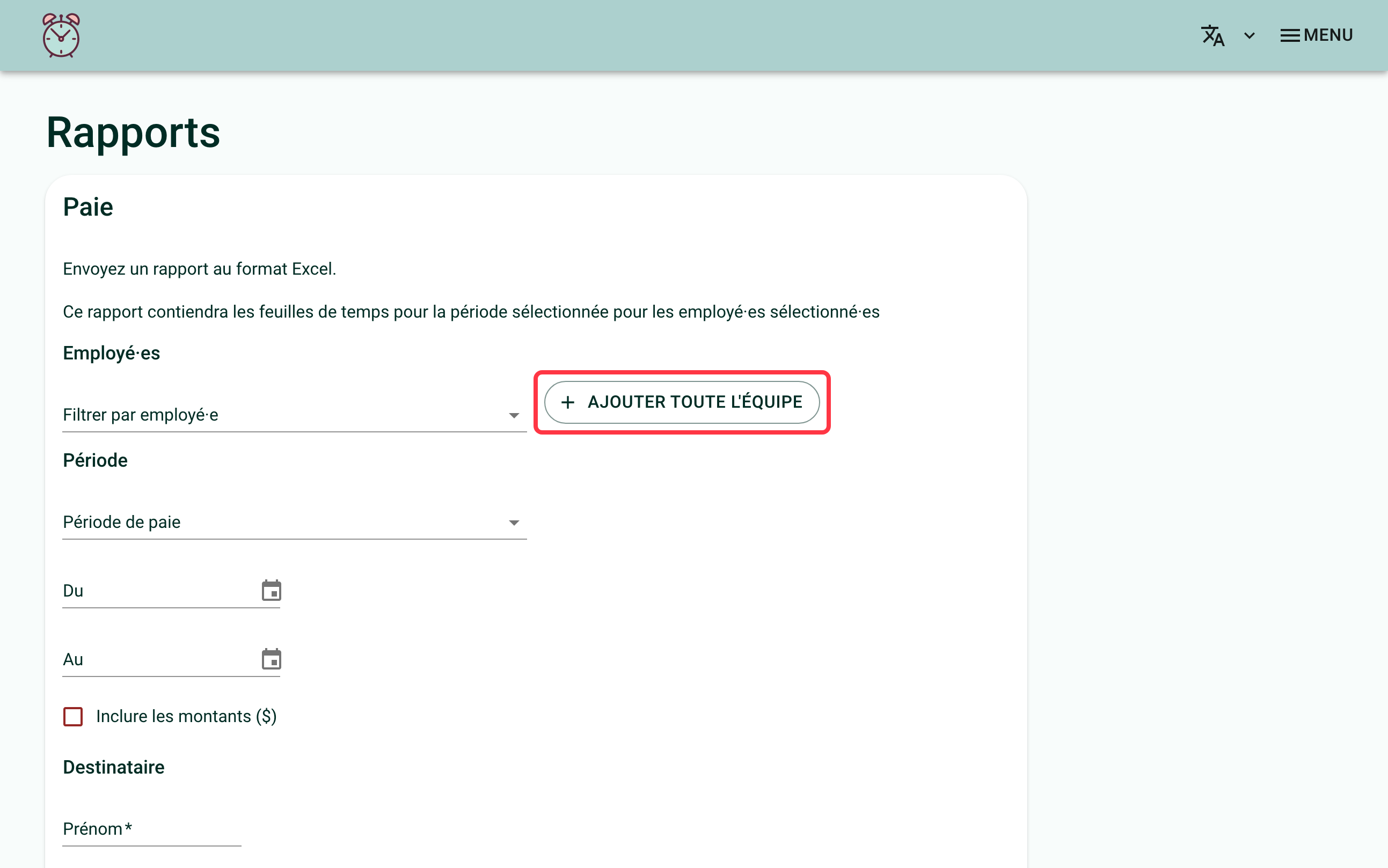
Go to the "Reports" page. The "Pay" section has everything you need to create and send the report.
Choose the employees
In the "Employees" field, select the people whose timesheets you want to include in the report. The "+ Add all employees" button adds them all at once.
To include someone whose tracking has ended, first turn on the "Display people whose tracking has ended." switch at the bottom of the page: they then become available in the "Employees" field.
Choose the period
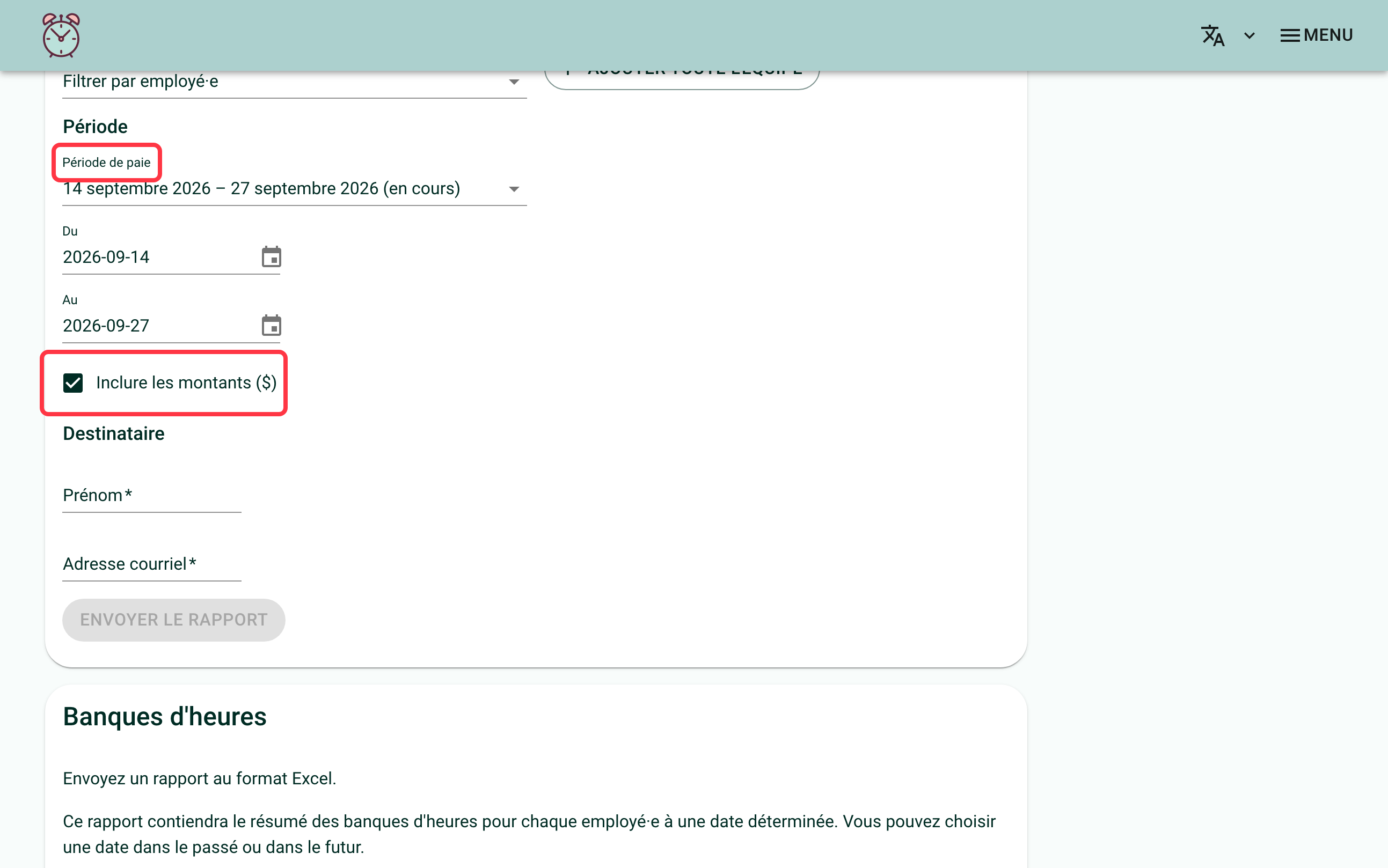
Fill in the "From" and "To" fields to set the period covered by the report.
If your organization has set a pay period in "My Organization", a "Pay period" field appears just above: choosing one fills in "From" and "To" automatically, with the right dates. You can still edit both fields by hand afterward, for example to cover more than one pay period at once.
If no pay period is set, the organization's administrators see instead of this field a line whose "My Organization" link leads to the setting.
Include amounts ($)
The Excel file always includes a "Pay periods" tab, which already groups each person's weeks by pay period: one row per person and per period, with the total hours. Check "Include amounts ($)" to add the dollar amounts owed to it. This box is unchecked by default: without it, the tab gives the hours, with no amounts.
Indicate the recipient
Fill in the "Name" and "Email" fields for the person who will receive the report. This can be you, or the person responsible for your accounting.
Then click the "send the report" button.
An email will be sent to the chosen email address. This email includes an Excel report showing all employees' timesheets for the selected period.

Finding the notes of the timesheets
The last column of the « Temps » and « Périodes de paie » tabs is called « Notes ». It brings together the comments employees wrote in their timesheets, so you can explain a gap without reopening each timesheet.
- On the « Temps » tab, a row's cell holds the notes of that row's week.
- On the « Périodes de paie » tab, it holds the notes of every week of the period.
Each note sits on its own line and starts with the day it relates to, for example "lun. 6 oct. : doctor's appointment in the afternoon". The cell stays empty when there is no note.
How are the amounts on the "Pay periods" tab calculated?
The tab has one row per person and per pay period (one week, if your organization has not set a pay period). It carries this note at the top: only signed weeks are paid; the hours of unsigned weeks stay visible, with no amount. A timesheet that has not yet been signed by the person it belongs to therefore pays nothing while it is still pending, even if all its hours are already entered.

Note that the tab's headers stay in French even when the application's language is set to English, since the exported file itself is always generated in French. The names below are what you will actually see in the spreadsheet, in quotes.
The "Heures à payer" ("Hours to pay") column is the person's contracted schedule for the period, holidays and time off included: multiplied by the hourly rate, it is what gives the base salary. Time off (sick leave, vacation, special leave) and public holidays falling on a day the schedule calls for otherwise stay shown in hours, in their own columns ("Maladies", "Vacances", "Congé spécial", "Fériés payés"), with no dollar amount: they are already part of the paid schedule, and an amount next to them would count them twice.
Only hours paid out of a bank rather than out of the normal schedule get their own column in dollars: paid overtime, paid sick leave, paid vacation, paid family leave and paid public holidays ("Heures fériées payées"). Overtime left in the bank rather than paid does not show up here: the report only shows in dollars what was actually paid out this period.
If a person's hourly rate changes partway through the period, the tab gives them two rows, one per rate, like two lines of a pay stub.
The "Période complète" ("Full period") column reads "Non" ("No") for a person whose tracking did not cover the whole period, for example someone hired partway through: the calculation then only covers the days actually tracked.
A worked example
Take someone paid $22.50/h, on a fixed 35 h/week schedule, in an organization whose pay period runs two weeks.
If both weeks of the period are signed, the tab shows "Heures à payer" ("Hours to pay") at 70 h (35 h × 2) and the matching dollar column at $1,575.00 (70 h × $22.50), whether or not the person worked exactly 35 h each week: "Heures à payer" follows the contracted schedule, not the hours actually worked.
If this person also has 5 h of paid overtime this period (rather than left in their bank), the tab adds "Heures supplémentaires payées" ("Paid overtime") at 5 h and its dollar column at $112.50 (5 h × $22.50), for a total of $1,687.50. Had those 5 h stayed in their bank instead, they would not show up on this tab at all: they show up instead in the hour banks report.
If one of the two weeks of the period is not yet signed when the report is sent, only the signed week counts toward "Heures à payer": the person is then paid for one week out of two, while the other awaits its signature.
A person with no hourly rate on file keeps every one of their dollar cells blank, rather than at $0.
If you need help with this, write to us at support@feuilledetemps.ca.