Configuring Overtime Premiums
In some provinces and territories, labor regulations require an overtime premium after a certain threshold.
For example, in Alberta, each hour over 8 hours per day and over 44 hours per week counts as 1.5 hours.
Feuille de Temps automatically calculates overtime premiums according to regulations, once the rule is configured for your organization.
To follow the instructions in this article, you will need access to the manager features.
How to Configure Overtime Premiums for the Organization?
Go to the "My Organization" page and scroll down until you see the "Organization Rules" section.
Daily Premiums
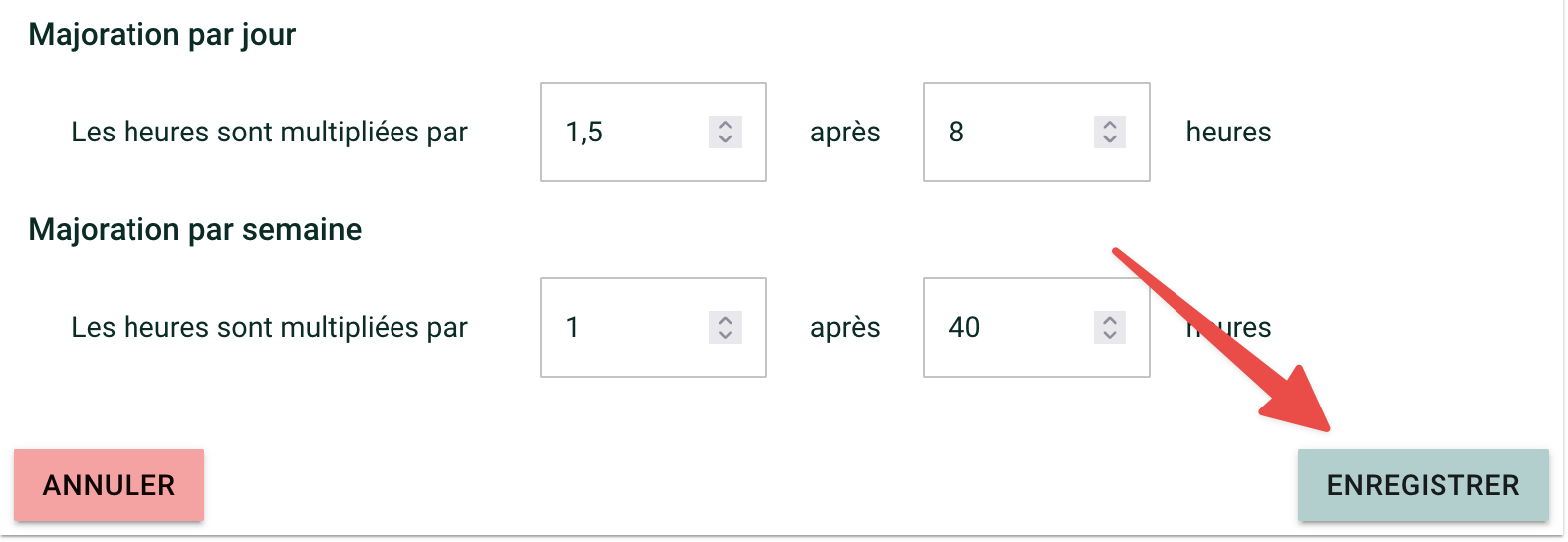
These are the overtime hours for each day. For example, if hours over 8 per day count as 1.5 hours, enter 1.5 and 8 in the corresponding fields. Decimals can be written with a comma or a point.
Some provinces add a second, higher tier, with its own multiplier. For example, in British Columbia, every hour past 12 h a day counts double: a first tier at 1.5 past 8 h, then a second at 2 past 12 h. In that case, also fill in the "Then multiplied by" fields and the second threshold, in hours, right below the first two.
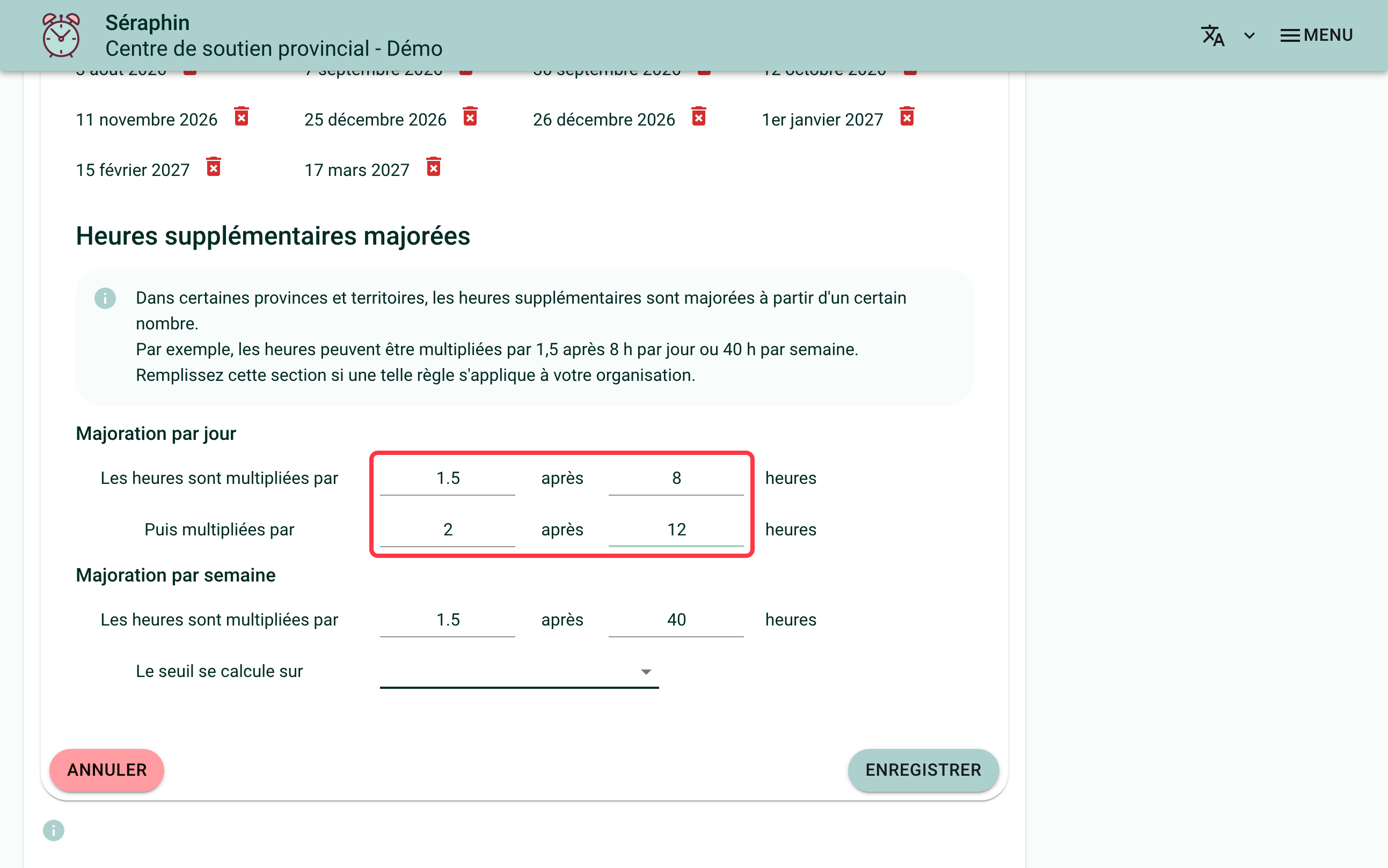
The second tier is optional: leave both its fields empty if your organization only has one. The second threshold must always be higher than the first.
Weekly Premiums
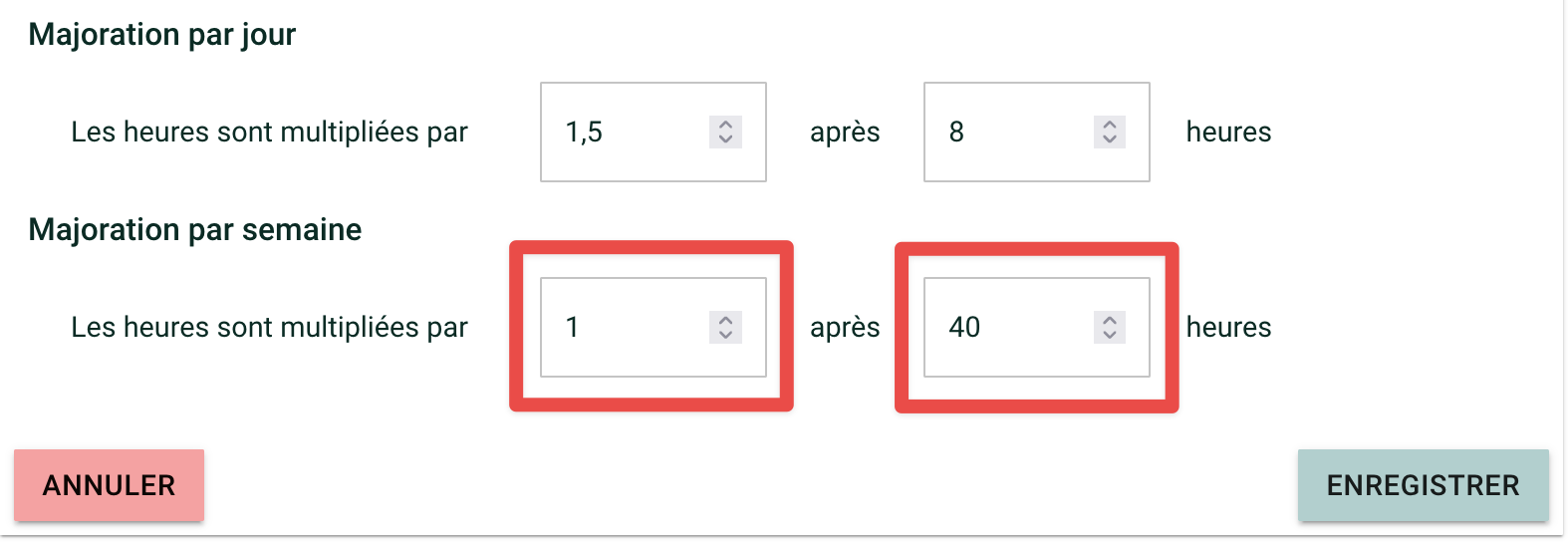
These are the overtime hours for each week. For example, if hours over 40 per week count as 1.5 hours, enter 1.5 and 40 in the corresponding fields.
What Span Does the Weekly Threshold Cover?
As soon as the weekly premium is turned on (the first of the two fields above is above 1), a "The threshold spans" field appears below it. It answers a different question from the threshold itself: over what span should hours be grouped before comparing them to that threshold?
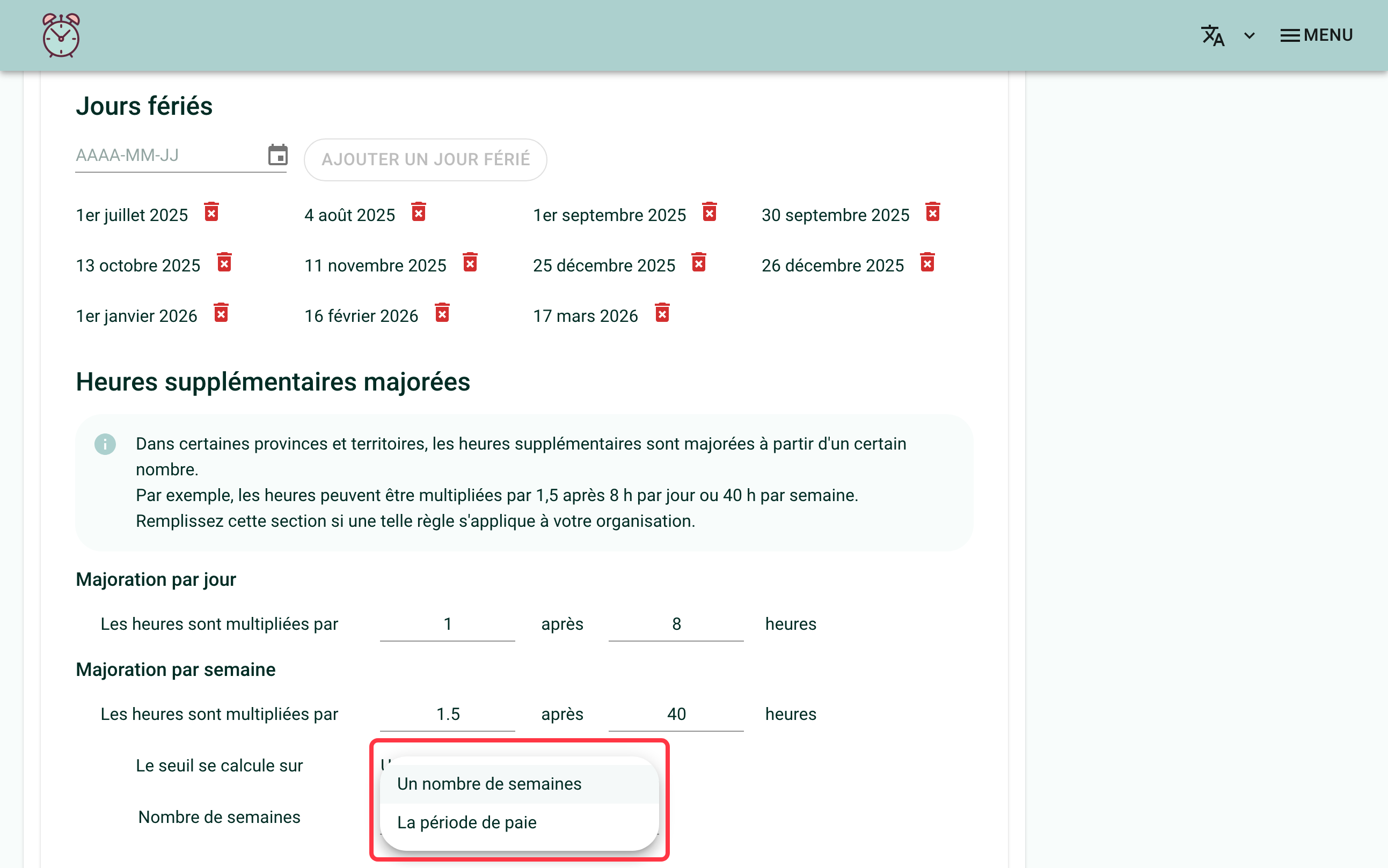
Two answers are possible:
- a run of weeks: the threshold applies to a block of one, two, three, or four consecutive weeks, rather than to each week on its own.
- the organization's pay period: the threshold follows your organization's pay period, set in "My Organization".
This article does not cover how to set up the organization's pay period, only this choice between the two. If your organization has not set a pay period yet, the "the pay period" option is refused on save, with a message inviting you to choose one first in "My Organization".
What Does "Two Weeks" Mean, Concretely?
Choosing "a run of weeks" reveals two more fields: "Number of weeks" (one, two, three, or four) and, above one week, "First week", which marks where the first period of that run begins.
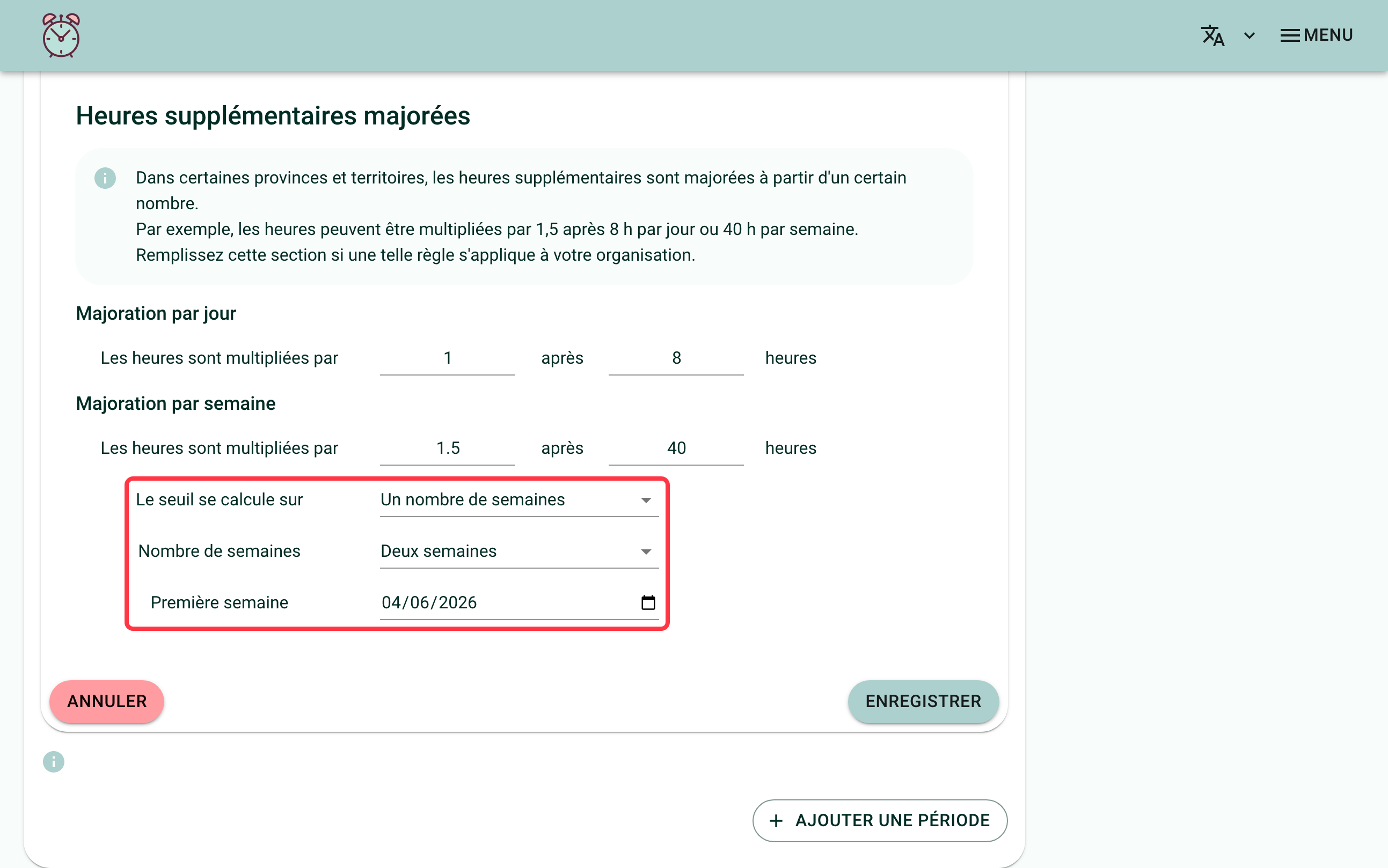
The threshold configured above (40 h in our example) applies as entered to the two weeks together, without being multiplied by the number of weeks: it is not 80 h. Take that 40 h threshold over a two-week block: someone who works 25 h one week and 20 h the next (45 h total) has 5 h of premium, because the total exceeds the 40 h threshold by 5 h. The same person working 15 h then 20 h (35 h total) has no overtime premium, the total staying under the 40 h threshold.
An incomplete period is judged pro rata to the number of weeks actually present. On that same two-week block with a 40 h threshold, if only one of the two weeks has been signed (for example at hiring, or because the other one is not filled in yet), the threshold applied to that single week is cut in half, to 20 h, not the full 40 h.
Save
Click on "Save," and the calculation will be automatically updated for your entire team.
Can This Setting Differ for One Person?
Yes. A manager can set, on one person's rules, a different answer than the organization's to the "The threshold spans" question. It is not the person themselves who chooses: you are the one who sets this on their rule, like the rest of their working conditions.
This matters when one organization employs people under different collective agreements, which is increasingly common in Québec.
Go to the "My Team" page, then click the "Rules" button in that person's section. The "The threshold spans" field appears there under the same condition as on the organization: only when the organization applies a weekly premium.
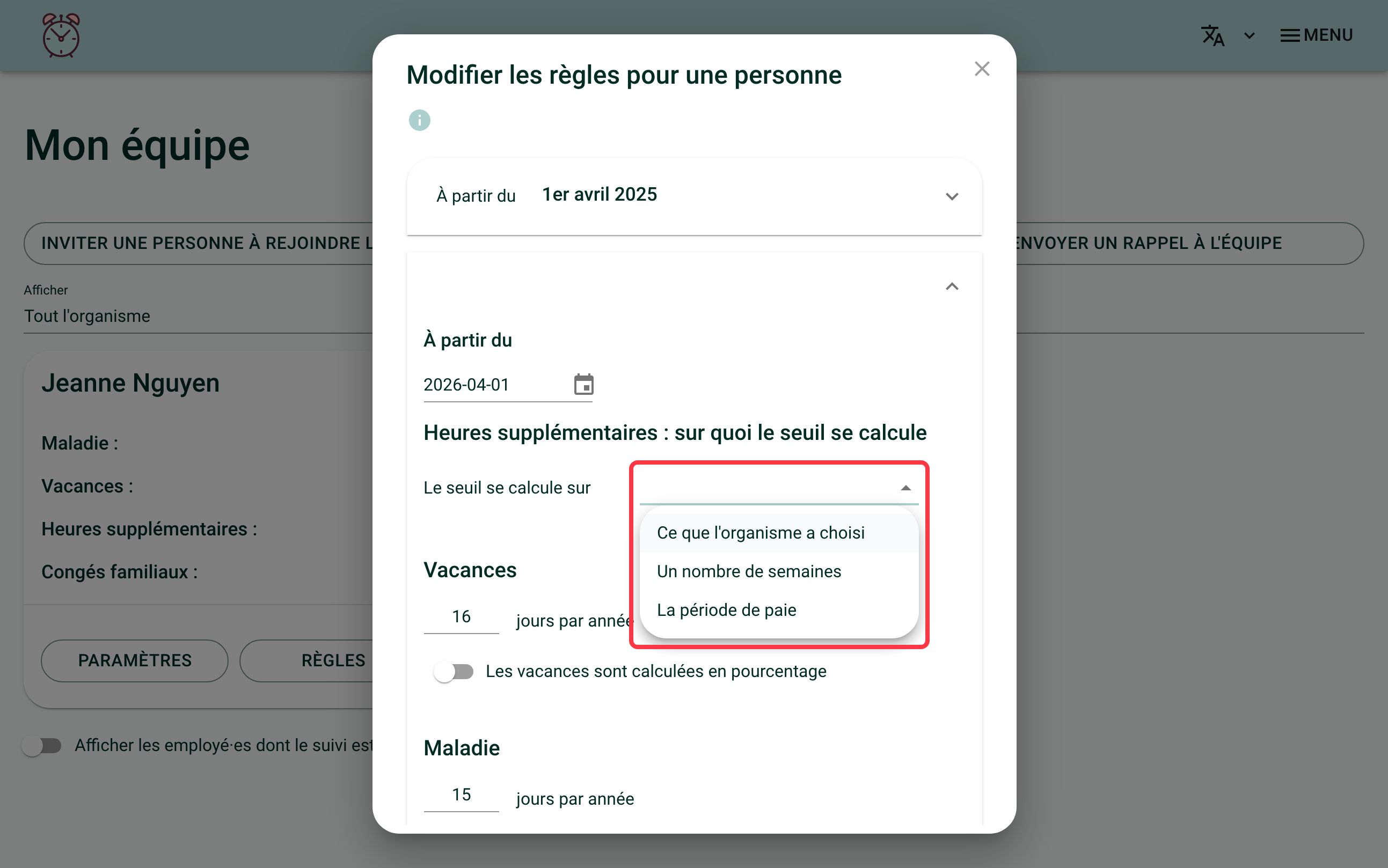
A third choice is added here: "What the organization chose". That is the default value, and it is not simply an empty field: it means this person keeps following the organization's setting, including the day it changes. Choosing "a run of weeks" or "the pay period" instead sets an answer specific to this person, which overrides the organization's.
Like the rest of a person's or an organization's rules, this setting is dated: it applies from the first day of the period that carries it, and periods already calculated keep the method they had. See Managing Rule Changes for an Employee for the difference between editing a period and creating a new one.
How to Verify that the Calculation is Applied?
In timesheets, when hovering over overtime hours, a message appears to inform employees that a specific calculation is applied.

If you need help with this, write to us at support@feuilledetemps.ca.