Configuring the Public Holiday Indemnity Calculation
When a public holiday falls during the week, Feuille de Temps credits the person with hours for that unworked day. Two ways of calculating that amount exist, and they do not always give the same result, for example for a team that switched to a four-day week.
To follow the instructions in this article, you will need access to the manager features.
How to Choose the Indemnity Calculation for the Organization?
Go to the "My Organization" page and scroll down until you see the "Organization Rules" section. The "Statutory holiday indemnity" section holds the "Indemnity calculation" field.
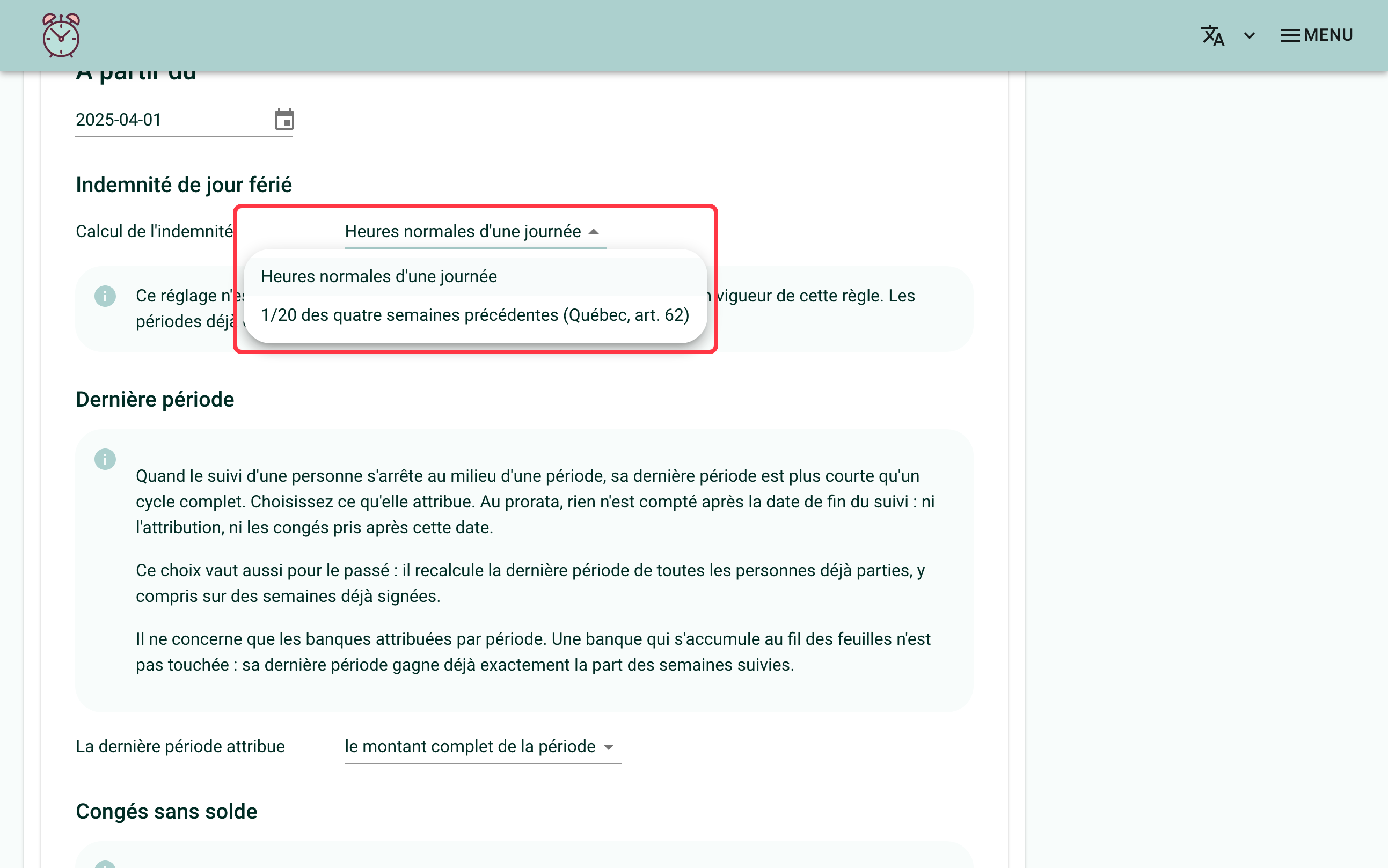
Two choices are offered:
- A normal day's hours: the person's normal hours for that day.
- 1/20 of the previous four weeks (Quebec, s. 62): the method set out in Quebec's labor law.
What Does Each Method Do?
A normal day's hours credits the person's configured hours, divided by the number of days checked on their schedule. A person working 35 h spread over 5 days therefore receives 7 h for a public holiday.
1/20 of the previous four weeks pays 1/20 of the hours paid during the four complete pay weeks preceding the week of the holiday, overtime excluded.
When Do the Two Methods Give the Same Result?
On a stable five-day schedule, without any absence, the two methods give exactly the same result. This is why most organizations have never noticed a gap between them: a five-day schedule is the most common case.
They diverge in two situations:
A Schedule That Is Not Five Days
A person on a 4-day, 7 h-per-day schedule (28 h a week) receives 7 h with "A normal day's hours," against 5.6 h with "1/20 of the previous four weeks." The historical calculation overpays here.
A person on a 6-day, 6 h-per-day schedule (36 h a week) receives 6 h with "A normal day's hours," against 7.2 h with the other method. The historical calculation underpays in this case.
Paid Hours That Differ From the Configured Schedule
The four weeks preceding the holiday may have been paid at a number of hours different from the person's usual schedule: a recent hire, unpaid leave, part-time hours that vary from week to week. The legal method then follows the hours actually paid, not the configured schedule.
What Happens for Someone Hired Less Than Four Weeks Ago?
With "1/20 of the previous four weeks," the calculation window looks back at the four complete pay weeks preceding the holiday. If the person has been in the role for less time than that, the window finds fewer paid weeks, but the calculation still divides by 20.
A person hired two weeks ago, working 35 h a week, has therefore 70 h paid within the window. The indemnity is 70 ÷ 20, or 3.5 h, rather than the 7 h they would have received with "A normal day's hours."
This is the expected result of this method for a recent hire. If a lower-than-expected figure appears for someone newly hired, this is the rule at play.
Is This Choice Retroactive?
No. Like every setting in the organization's rules, the indemnity calculation applies from the effective date of the rule that carries it. Periods already calculated keep the method they were computed with.
To change the method starting from a specific date rather than from the beginning of the current period, see Managing Rule Changes for the Organization.
Who Decides Which Method to Use?
The choice belongs entirely to your organization. Feuille de Temps lets you follow the method set out in Quebec's labor law, but does not impose it.
New organizations created in Quebec start with "1/20 of the previous four weeks" already selected. Existing organizations keep "A normal day's hours" unless they choose to change it themselves.
If you need help with this, write to us at support@feuilledetemps.ca.